Mike Kazimer at Pinkbike penned a good summation of 32″ wheels and the industry’s rush to endorse this new “standard”. I’ve been holding my tongue with regards to this new wheel size. For reference sake, and a full disclosure: I have not ridden this wheel size nor had any wheels of said size in the shop to date. I have had a small handful of inquires from potential clients testing the waters of interest. They’re proverbially what you could quite literally call “Tire Kicking”. I can make some assumptions regarding the size without even riding them given my now lengthy time at the bench and many years of design of bicycles under my belt.
First, given its overall larger diameter to 29″ wheels, its going to smooth out surfaces even more when compared to a 29″ wheel. Given that same overall diameter difference, the contact patch is going to be larger, thus traction will increase. If we compare the circumferences of a 29″ wheel to a 32″ wheel, and lets say we lay those measurements flat on the ground, a 32″ circumference is going to be longer than a 29″ circumference. Recall the whole debate “Which is faster? 26″ or 29??” One rotation of a 32″ wheel will travel a greater distance than a 29″ wheel, hence it will have a distinct advantage in a race for all the reasons mentioned above but also one that I haven’t heard mentioned: It will cover more ground with one rotation than a 29″ will cover. And you can get into arguments about which one takes more energy to bring up to speed, but once up to speed, that 32″ wheel is going to carry more momentum. Its just math and physics at play here. And given their size in comparison to a 29″ wheel, certain clients/riders who are in the 6’2″+ range will finally see a wheel size that is proportional to their stature. That certainly is a plus of this wheel size. However, since I have not ridden the wheel, I am not going to judge the wheel size on these merits. I’ll leave that for a later date if/when I ever am commissioned to build around this wheel size. What I want to address is something much larger than a wheel size. Its the discussion of how the industry consistently sells the hype of new bobbles as a means of selling more product and attempting to convince consumers and riders alike that they need these new bobbles in order to have fun on a bike. Not only is this logic and strategy unwise and costly for the industry, its in direct contrast to what I consistently heart from riders’ actual wants: Increased durability and serviceability of the products we create and a reduction in the cost associated with those same products we introduce.
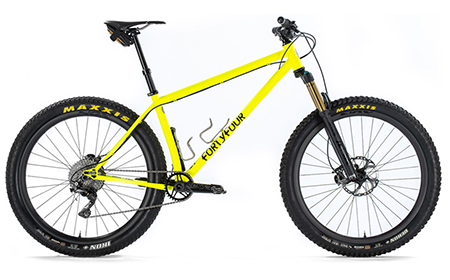
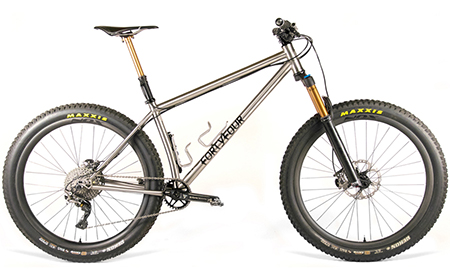
As a framebuilder, I feel my clan is partly to blame for helping to indulge the industry on its own whims. There’s always a perceived rush to claim the “who’s first” crown when it comes to new standards and tech. The first builder to build with X new wheel size! The first builder to build around X new component. I can speak from some good experience here when I say the following: It’s a bunch of bunk. In many cases these endeavors are a complete waste of time, resources and of our collective skill. And for what? Hardly innovation. I didn’t “invent” plus nor did any of the builders who have built around 32″ invent 32″ wheels. I can draw some reasonable conclusions of their perceived advantages without even touching the wheels given my experience. But I was one of the first to build around a plus sized tire/wheel. I recall getting early released product in the mid 2000’s and building up a wheelset around 29plus. The above image is from 2013. Mixed wheels were becoming a thing, fat bikes were on the back foot having had their spotlight and plus was on the rise. The industry was toying with tire size and so it made an intermediate tire size between XC and FAT: Plus. Think 2.8″. Which was reduced to 2.6″ due to the tire needing to have ultra thin sidewalls because if the tire did have sufficient wall thickness, it became a huge anchor of rotational weight and a pig out on the trail. Fat bikes are fat bikes: Meant for snow and crazy terrain not traversable by normal tire sizes. Come February in the dead of winter like we’re in now, 4.5-5″ fat bike tires in 26″ or 27.5″ wheels are the difference between crawling out of your skin as a cyclist or maintaining your sanity. Fat bikes have their place. Plus had the effect of pushing the mountain bike industry past its XC and road roots into growing big boy pants and dropping these pretenses. Forward geo, droppers, suspension… all these trends and larger volume tires to match the terrain and progressive riding style of the 21st century helped push the mountain bike into its current state and shed its XC and road sea anchors for good. The industry matured in this sense and it was good progress. But I see glimpses of this same hype that I saw around Plus that I do around 32″ wheels. What spills out of this I do not know. But there is a rush to be the “first” with this stuff and I personally caution anyone against this urge. And this isn’t to say that the industry should not be constantly exploring ideas, seeking progression and striving for new innovations. The design process allows for this. But is this stuff the consumer should have access to yet? I’m not so sure. Is this something that should remain at the XC race level and see what spills out of it before its adapted for consumers? I will admit I’m of this mind.
But circling back to my earlier point above about being one of the “first” to build around plus sized wheels/tires: NONE of that product is in my possession right here right now in 2026. I have none of those tires. None of those wheels. No bike I personally have built for myself is in my possession. NO bike I built is being ridden or is part of my current stable. All of my fiddling didn’t translate to long term success. I sold and built a handful of plus sized bikes. I think I only built 1… ONE 29+ bike for a client. I built a handful of 27.5 plus bikes. And of all the wheelsizes that does make some sense for a lot of riders 6’1″ and below, 27.5″ wheels are THAT wheel size, but last I read, a very large tire manufacturer discontinued all of its 27.5″ tire sizes in favor of opening 32″ tire size molds. If that’s not a disservice to a lot of short statured riders, then I don’t know what is. Certainly many of these riders can get away with 29″ wheels but when it comes to proportion, 27.5″ has its place retaining all the positive attributes of 29″ wheels while consistently delivering on the strength and agility of the industry’s old standard 26″ wheels. I stand by those statements because I’ve extensively tested and built around both 29 and 27.5 with many years under my belt atop 26″ wheels. And again, this is saying this not having ridden or built around 32″ wheels. And again, we’ll leave that comparison for a later date if it ever comes. This isn’t a discussion about the merits of 32″ wheels. This is a discussion about the industries focus in the wrong places to keep itself afloat.
My own recommendations to my fellow builders and the industry at large?
Builders: Build to a standard. Improve your craft. Hone your skills and strive for perfection. Resist to be the “first”. Lead by example with durable product, built to a standard and craft product that fits. Spread the joy of life by bicycle.
The Industry: We need product that’s built to last and affordable. In a sea of expensive bobbles, work towards longevity of product and longevity of your business. Wherever possible, look to partner with local manufacturing resources. On-shore product manufacturing. Make that part of your business plan. Make longevity and long term profitability part of your business plan. Reassess priorities to long term steady growth and look away from short term gains. Partner with builders to bring these types of products to market. Reinventing the wheel is a waste of time. Pursuing innovation at the race level is essential but only make this product available to the public when there is a proven advantage FOR the consumer that is measurable in the demands they’re requesting. To quote my grandmother “You need to LISTEN”. “Weight” and “race winning” aren’t what the consumers are asking for. Quite literally no consumer I have ever spoken to in my two decades at the bench cares about race results. That quite literally does not sell bicycles to the majority of cyclists nor does it appeal to aspiring cyclists.
We need to collectively be telling and marketing the story of the joy of cycling. That sells product. That turns consumers into riders. And once those same consumers have discovered the joy and passion of life atop a bicycle, they’re riders for life. And THAT is what sells bicycles.


Reinventing the wheel
Mike Kazimer at Pinkbike penned a good summation of 32″ wheels and the industry’s rush to endorse this new “standard”. I’ve been holding my tongue with regards to this new wheel size. For reference sake, and a full disclosure: I have not ridden this wheel size nor had any wheels of said size in the shop to date. I have had a small handful of inquires from potential clients testing the waters of interest. They’re proverbially what you could quite literally call “Tire Kicking”. I can make some assumptions regarding the size without even riding them given my now lengthy time at the bench and many years of design of bicycles under my belt.
First, given its overall larger diameter to 29″ wheels, its going to smooth out surfaces even more when compared to a 29″ wheel. Given that same overall diameter difference, the contact patch is going to be larger, thus traction will increase. If we compare the circumferences of a 29″ wheel to a 32″ wheel, and lets say we lay those measurements flat on the ground, a 32″ circumference is going to be longer than a 29″ circumference. Recall the whole debate “Which is faster? 26″ or 29??” One rotation of a 32″ wheel will travel a greater distance than a 29″ wheel, hence it will have a distinct advantage in a race for all the reasons mentioned above but also one that I haven’t heard mentioned: It will cover more ground with one rotation than a 29″ will cover. And you can get into arguments about which one takes more energy to bring up to speed, but once up to speed, that 32″ wheel is going to carry more momentum. Its just math and physics at play here. And given their size in comparison to a 29″ wheel, certain clients/riders who are in the 6’2″+ range will finally see a wheel size that is proportional to their stature. That certainly is a plus of this wheel size. However, since I have not ridden the wheel, I am not going to judge the wheel size on these merits. I’ll leave that for a later date if/when I ever am commissioned to build around this wheel size. What I want to address is something much larger than a wheel size. Its the discussion of how the industry consistently sells the hype of new bobbles as a means of selling more product and attempting to convince consumers and riders alike that they need these new bobbles in order to have fun on a bike. Not only is this logic and strategy unwise and costly for the industry, its in direct contrast to what I consistently heart from riders’ actual wants: Increased durability and serviceability of the products we create and a reduction in the cost associated with those same products we introduce.
As a framebuilder, I feel my clan is partly to blame for helping to indulge the industry on its own whims. There’s always a perceived rush to claim the “who’s first” crown when it comes to new standards and tech. The first builder to build with X new wheel size! The first builder to build around X new component. I can speak from some good experience here when I say the following: It’s a bunch of bunk. In many cases these endeavors are a complete waste of time, resources and of our collective skill. And for what? Hardly innovation. I didn’t “invent” plus nor did any of the builders who have built around 32″ invent 32″ wheels. I can draw some reasonable conclusions of their perceived advantages without even touching the wheels given my experience. But I was one of the first to build around a plus sized tire/wheel. I recall getting early released product in the mid 2000’s and building up a wheelset around 29plus. The above image is from 2013. Mixed wheels were becoming a thing, fat bikes were on the back foot having had their spotlight and plus was on the rise. The industry was toying with tire size and so it made an intermediate tire size between XC and FAT: Plus. Think 2.8″. Which was reduced to 2.6″ due to the tire needing to have ultra thin sidewalls because if the tire did have sufficient wall thickness, it became a huge anchor of rotational weight and a pig out on the trail. Fat bikes are fat bikes: Meant for snow and crazy terrain not traversable by normal tire sizes. Come February in the dead of winter like we’re in now, 4.5-5″ fat bike tires in 26″ or 27.5″ wheels are the difference between crawling out of your skin as a cyclist or maintaining your sanity. Fat bikes have their place. Plus had the effect of pushing the mountain bike industry past its XC and road roots into growing big boy pants and dropping these pretenses. Forward geo, droppers, suspension… all these trends and larger volume tires to match the terrain and progressive riding style of the 21st century helped push the mountain bike into its current state and shed its XC and road sea anchors for good. The industry matured in this sense and it was good progress. But I see glimpses of this same hype that I saw around Plus that I do around 32″ wheels. What spills out of this I do not know. But there is a rush to be the “first” with this stuff and I personally caution anyone against this urge. And this isn’t to say that the industry should not be constantly exploring ideas, seeking progression and striving for new innovations. The design process allows for this. But is this stuff the consumer should have access to yet? I’m not so sure. Is this something that should remain at the XC race level and see what spills out of it before its adapted for consumers? I will admit I’m of this mind.
But circling back to my earlier point above about being one of the “first” to build around plus sized wheels/tires: NONE of that product is in my possession right here right now in 2026. I have none of those tires. None of those wheels. No bike I personally have built for myself is in my possession. NO bike I built is being ridden or is part of my current stable. All of my fiddling didn’t translate to long term success. I sold and built a handful of plus sized bikes. I think I only built 1… ONE 29+ bike for a client. I built a handful of 27.5 plus bikes. And of all the wheelsizes that does make some sense for a lot of riders 6’1″ and below, 27.5″ wheels are THAT wheel size, but last I read, a very large tire manufacturer discontinued all of its 27.5″ tire sizes in favor of opening 32″ tire size molds. If that’s not a disservice to a lot of short statured riders, then I don’t know what is. Certainly many of these riders can get away with 29″ wheels but when it comes to proportion, 27.5″ has its place retaining all the positive attributes of 29″ wheels while consistently delivering on the strength and agility of the industry’s old standard 26″ wheels. I stand by those statements because I’ve extensively tested and built around both 29 and 27.5 with many years under my belt atop 26″ wheels. And again, this is saying this not having ridden or built around 32″ wheels. And again, we’ll leave that comparison for a later date if it ever comes. This isn’t a discussion about the merits of 32″ wheels. This is a discussion about the industries focus in the wrong places to keep itself afloat.
My own recommendations to my fellow builders and the industry at large?
Builders: Build to a standard. Improve your craft. Hone your skills and strive for perfection. Resist to be the “first”. Lead by example with durable product, built to a standard and craft product that fits. Spread the joy of life by bicycle.
The Industry: We need product that’s built to last and affordable. In a sea of expensive bobbles, work towards longevity of product and longevity of your business. Wherever possible, look to partner with local manufacturing resources. On-shore product manufacturing. Make that part of your business plan. Make longevity and long term profitability part of your business plan. Reassess priorities to long term steady growth and look away from short term gains. Partner with builders to bring these types of products to market. Reinventing the wheel is a waste of time. Pursuing innovation at the race level is essential but only make this product available to the public when there is a proven advantage FOR the consumer that is measurable in the demands they’re requesting. To quote my grandmother “You need to LISTEN”. “Weight” and “race winning” aren’t what the consumers are asking for. Quite literally no consumer I have ever spoken to in my two decades at the bench cares about race results. That quite literally does not sell bicycles to the majority of cyclists nor does it appeal to aspiring cyclists.
We need to collectively be telling and marketing the story of the joy of cycling. That sells product. That turns consumers into riders. And once those same consumers have discovered the joy and passion of life atop a bicycle, they’re riders for life. And THAT is what sells bicycles.